A paper's knowledge graph
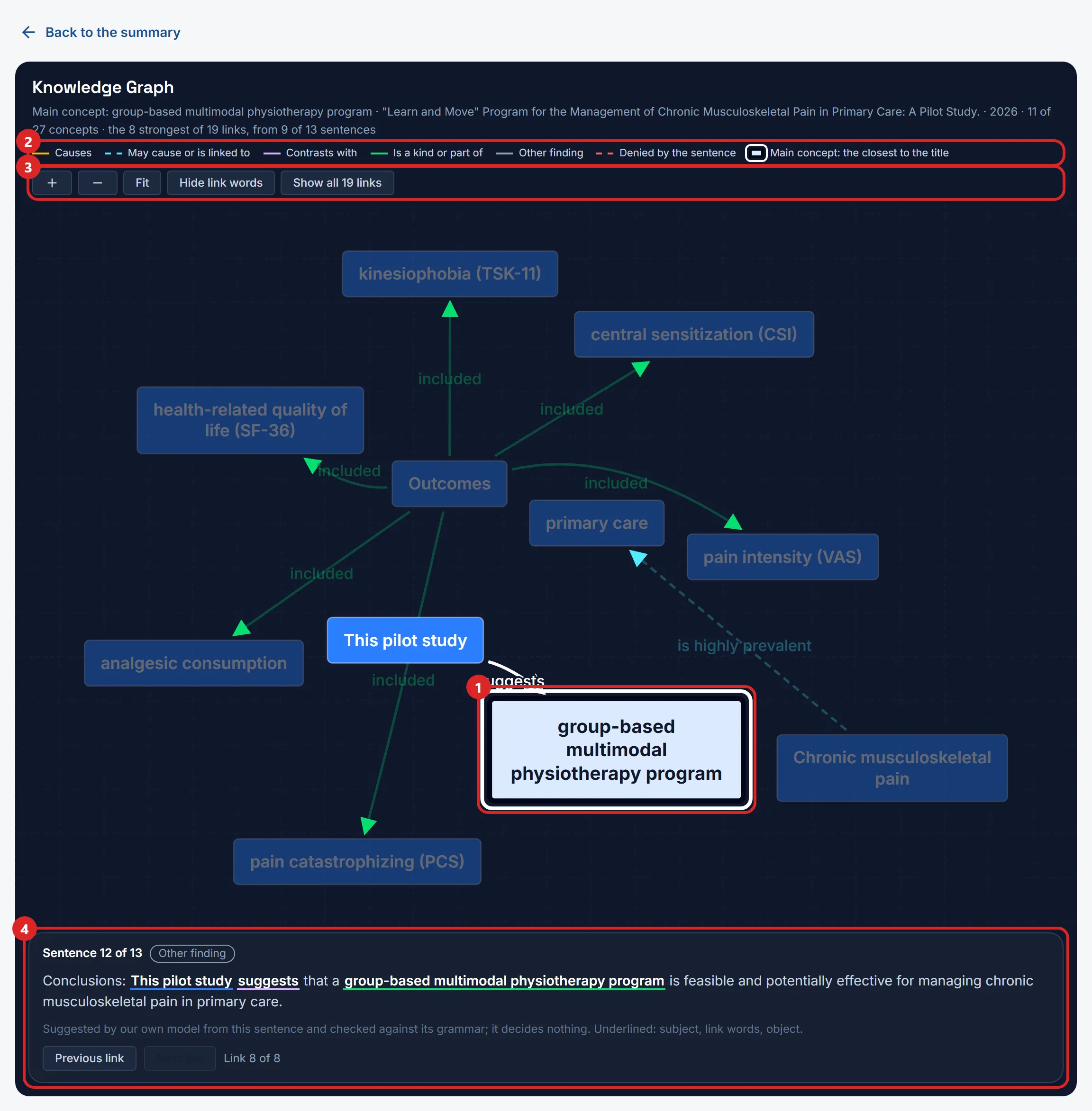
After Summarise, each paper with an abstract has a knowledge graph: its abstract's key findings drawn as concepts in boxes, linked by arrows labelled with the sentence's own words. Click anywhere on the paper's card in the Summary step but its title; the graph fills the page, and Back to the summary returns to the cards. It is there in both kinds of review. The graph is a picture only: no screening decision, PRISMA count, extracted value or export reads it.
- The main concept sits in the centre, in a light box with a dark border and a white ring: the concept closest in meaning to the paper's title. The line under the heading names it and says how many concepts and links were drawn, from how many of the abstract's sentences.
- The legend names every colour. Each kind of link has its own colour, and none is the boxes' blue. A link that Causes is orange; one that May cause or is linked to is cyan and dashed; Contrasts with is purple; Is a kind or part of is green; any Other finding is grey. A finding the sentence denies is red, with short dashes, its words preceded by not where they do not deny it already.
- Zoom in, Zoom out and Fit move the picture; Hide link words leaves the arrows alone, and Show link words brings the words back. Drag a box to move it; drag the background to pan. A long abstract can give many links, so the graph opens on its 8 strongest -- those touching the main concept first, then those joining the concepts with the most links -- and the line under the heading says so; Show all {n} links draws every one, and Show the 8 strongest links goes back.
- Click a box to light its links and fade the rest. Click a link to see its sentence on the card at the foot, Sentence n of m, with its subject, link words and object underlined. Previous link and Next link step through the links drawn, in the abstract's order (Link n of m); with no link picked, Show the first link starts at the first. Each link's words are placed where no box and no other link's words cover them.
Only findings are drawn -- results, conclusions and facts the abstract states as established -- never its aims or methods. Each link is one statement of a sentence: the sentence's whole subject, its own link words and their whole object, copied word for word. The same words, in any case, are one box, so a finding's details (how much, in whom, compared with what) join it.
Before a link is kept, our reader checks it against the grammar of its own sentence, in English and Portuguese alike. A link is left out where it joins words of two different statements of the sentence, where another clause stands between its parts, or where its subject or object is only small grammar words (such as we or of). Small words at the edge of a box (and, of) are trimmed, and a not, no or without just before the object marks the link as denied. A link left out costs little; a link the sentence does not say would mislead. Our own small model, run on our servers, reads each abstract in English or Portuguese, in the background, as soon as you press Summarise; a paper whose abstract has not changed is not read again.